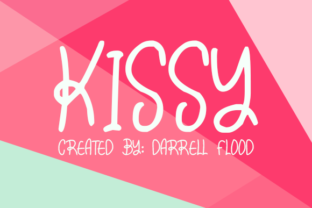
Kissy Script Handwritten Font for Playful, Personal Craft Projects
There’s that moment—right after I’ve finished pouring my lavender-vanilla soy candles—when I reach for the label template and pause. The scent is warm, the wax is smooth, but the text feels flat. That’s when I open my font library and click on Kissy. Instantly, the mood shifts: soft curves, gentle bounce, a whisper of whimsy in every letter. Kissy isn’t just another script handwritten font—it’s the kind of typeface that makes handmade feel *hand-loved*. Created by Darrell Flood, this Script Handwritten font carries a lightness and approachability that’s rare in display fonts, especially ones built for real-world craft use.
Kissy for Greeting Cards and Handwritten-Style Stationery
I test Kissy first on greeting cards—birthday, thank-you, new baby—because those small moments demand sincerity, not stiffness. Its soft characters flow like ink from a fine-tip pen, with subtle variation in stroke weight that mimics natural handwriting. It’s not overly formal, not too cursive, and never stiff. For printed cards, I pair Kissy with a clean sans serif (like Montserrat or Poppins) for body text—keeping hierarchy clear while letting the Script Handwritten font shine in titles and names. Because Kissy is designed as a display font, I avoid using it for full paragraphs—but for “Happy Birthday,” “With Love,” or “Thank You So Much,” it adds warmth without sacrificing readability.
Kissy for Candle Labels and Small Product Tags
When designing candle labels in Canva or Illustrator, I always check how Kissy renders at 10–12pt on a 2” x 3” sticker. Good news: it holds up beautifully. The rounded terminals and open counters keep letters legible even when scaled down—critical for Cricut and Silhouette users cutting vinyl or printable tags. I use Kissy for scent names (“Honey & Sage,” “Cozy Rain”) and brand lines (“Hand-poured in Portland”), then back it with a simple serif or geometric sans for ingredients or warnings. As a Script Handwritten font, Kissy adds artisanal credibility without looking fussy—perfect for boutique packaging where customers notice texture, tone, and typography all at once.
Kissy for Wedding Invitations and Elegant Branding
For wedding stationery—especially welcome signs, menu cards, or envelope addressing—I lean into Kissy’s quiet elegance. It’s playful, yes, but also refined—soft without being saccharine. When used in gold foil on ivory cardstock or laser-cut wood, Kissy brings tactile charm to digital designs. I often layer it over watercolor backgrounds or pair it with a delicate serif (think Playfair Display) for contrast. Since Kissy is a single-weight Script Handwritten font, I rely on size, spacing, and color to create visual rhythm—not bold or italic variants. That simplicity keeps the focus on the message and the moment.
Kissy for Printable Wall Art and Digital Downloads
My best-selling printable wall art—“You Are Enough,” “Breathe,” “Grow Wild”—all started with Kissy. Its soft characters lend emotional resonance to short phrases, making them feel personal rather than generic. As a Fonts asset for digital creators, Kissy works seamlessly in Procreate, Photoshop, and Google Slides. I export high-res PNGs with transparent backgrounds so buyers can layer text over their own photos or patterns. Because Kissy includes standard OpenType features (ligatures, stylistic alternates), I occasionally swap in a swash capital for “W” or “Y” to add subtle flair—just enough to elevate a $7 download into something collectors save and print again.
Kissy for Farmhouse Signs and Craft Fair Displays
At last month’s craft fair, I hung a reclaimed-wood sign above my booth that read “Made With Care.” I cut it in vinyl using Kissy, and more than one customer paused to ask, “Is that hand-lettered?” That’s the magic of this Script Handwritten font—it blurs the line between digital precision and human touch. For wooden signs, chalkboard prints, or painted mugs, Kissy scales cleanly up to 120pt without jagged edges. Just remember: if you’re cutting with a machine, convert text to outlines first—and always do a test cut on scrap material. Kissy’s generous spacing and moderate x-height make it forgiving for both beginners and seasoned crafters.
Kissy for Tote Bags, Shirts, and Seasonal Merchandise
For screen-printed totes and heat-transfer shirts, I keep Kissy to short, impactful phrases: “Good Vibes Only,” “Hello Sunshine,” “Coffee & Kindness.” Its friendly, unpretentious energy fits perfectly with spring collections, holiday gift sets, or summer markets. As a Fonts choice for merchandise, Kissy avoids trend fatigue—it’s timeless enough for year-round use but fresh enough to stand out next to overused brush scripts. I always verify commercial licensing before uploading SVG files to Etsy or bundling Kissy into editable Canva templates. And because it’s a well-hinted Script Handwritten font, it renders crisply on web previews, mockups, and mobile listings—helping shoppers *feel* the craft before they click “Add to Cart.”
How to Use Kissy Most Effectively in Your Next Project
- Stick to short phrases: Names, titles, quotes, and labels—Kissy shines brightest under 6 words.
- Pair wisely: Contrast its soft curves with a structured sans serif (e.g., Inter, Lato) or classic serif (e.g., Merriweather) for balance.
- Test before cutting: Preview at actual size in your design software—especially for stickers under 1.5” or embroidery digitizing.
- Check file formats: Ensure your version of Kissy includes OTF and TTF files for maximum compatibility across platforms.
- Review licensing: Confirm commercial use rights if selling physical goods, digital templates, or POD items.